A collection of my recently published and upcoming papers, reports, blogs and interviews.
Jump to:
Latest
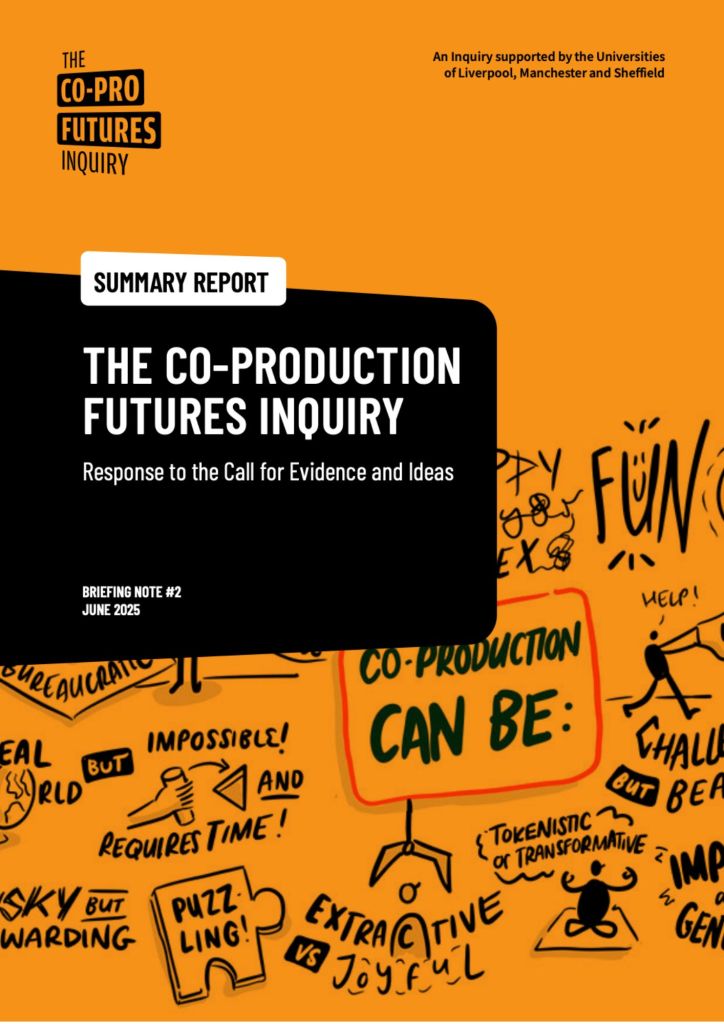
The Co-production Futures Inquiry: Response to the Call for Evidence and Ideas (2025)
The Co-Production Futures Inquiry aims to propose actionable measures to overcome systemic barriers to participatory and co-produced research within universities and the broader higher education sector. In this report, I synthesise the evidence gathered through the Inquiry’s national Call for Evidence and Ideas, conducted between 5 December 2024 and 28 February 2025. I outline the size and scale of the problem, as well as solutions currently being tried and tested around four main themes: Fair Funding, Negotiated Ethics, Equitable Partnerships, and Responsible Metrics.
Cite this: Vince-Myers, B. (2025) The Co-Production Futures Inquiry: Response to the Call for Evidence and Ideas. The University of Sheffield. Report. https://doi.org/10.15131/shef.data.29598833.v1.
Doctoral thesis
The (Mis)use of Indigenous Knowledge in International Relations (2024)
My doctoral thesis explores whether and how the African concept of ubuntu is being used as a tool for peacebuilding at the national, local, and everyday levels in South Africa. Through document analysis and in-depth interviews and observations in South Africa, it outlines how ubuntu is used by community-based actors and individuals as a way to build relational peace, as well as how it is misused in political and academic discourse. The research contributes new empirical insight into the potential and limitations of mobilising Indigenous knowledge for peace in post-conflict, post-colonial contexts, and highlights how Indigenous concepts are susceptible to romanticisation and co-optation in academic and political discourse.
Cite this: Vince-Myers, Bryony (2024) The mis(use) of Indigenous knowledge in International Relations: how ubuntu is used as a tool for peacebuilding in South Africa. PhD thesis, University of Sheffield.

Blogs
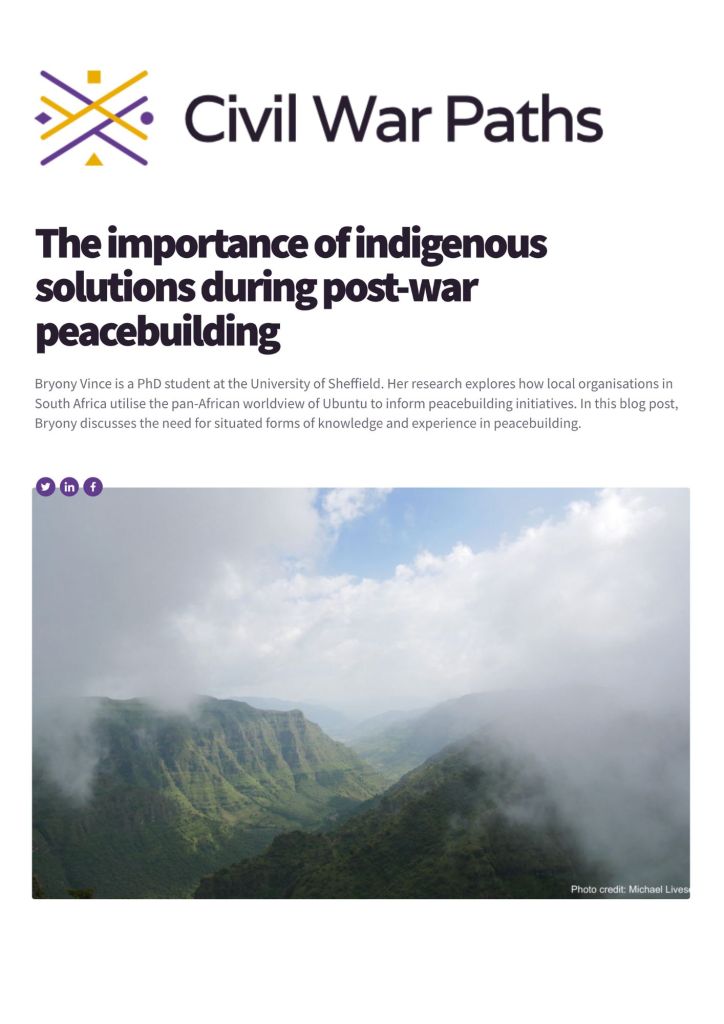
The importance of indigenous solutions during post-war peacebuilding (2021)
In this blog for Civil War Paths, I discuss the need for situated forms of knowledge and experience in peacebuilding. I call for more empirically grounded, collaborative, and contextually specific research into how people understand and build peace in their day-to-day lives. It draws on my doctoral research, which explores how the African worldview of ubuntu is used by community-based actors a tool for local peacebuilding, and how it is misused in political and academic discourse.
Cite this: Vince, B. (2021) The importance of Indigenous solutions during post-war peacebuilding, Civil War Paths Blog. Available at: https://www.civilwarpaths.org/eurocentrism-andpeacebuilding/.
Journal articles
Hopes, Hiccups and Aspirations of PGRs doing Participatory Research: Reflections from a Creative and Collaborative Research Project (forthcoming)
In this co-authored article, we reflect upon a project conducted at the University of Sheffield that focused on the experiences of postgraduate researchers (PGRs) doing participatory research. Through collaborative workshops with 20 PGRs, we found that while doctoral research remains positioned as an individual endeavour, PGRs are committed to participatory research but need time, space, resources and dialogue to enable them to pursue more equitable and inclusive research methodologies. We conclude with a call to action that enables PGRs to showcase the power of their participatory work. Our article contributes to understandings of doctoral researchers’ experiences by utilising our own creative and participatory agendas and provides novel approaches via our diverse, creative and lively methodologies.
Co-authors: Ankita Mishra, Lauren White, Kirsty Liddiard, Palwasha Amanullah, Ziyad Mohammed O Basahal, Andrew R Belfield, Danica JM Darley, Myra Mufti, Sophie Phillips, Kaltum O Rivers, Tessa E Sawyer, Elena M Simon, Sheli Smith, Siyi Wang, Victoria Worthington.

Under review with Qualitative Research
Who bears the brunt? Conceptualising everyday peace as a form of labour in Cape Town, South Africa
Everyday acts performed by ordinary people in their day-to-day lives have the potential to contribute to the de-escalation of conflict and building peaceful relationships at the community level. Recent scholarship in Peace and Conflict studies has called for the recognition of these everyday acts as a legitimate form of peacebuilding (Robinson, 1997; Vaittinen et al., 2019; Mac Ginty, 2021). While this research has (re)positioned the community-level as a meaningful site for peacebuilding and encouraged the broadening of formal peace interventions to include seemingly mundane and informal acts, we have yet to fully explore who is performing this everyday peace, why, under what conditions, and the personal, social, and economic impacts this has on those individuals. Drawing on in-person qualitative fieldwork in South Africa, this paper conceptualises everyday peace as a form of labour to reveal the relational, emotional, and voluntary work that people undertake to transform conflict in their communities. In doing so, it highlights how women and other marginalised groups in Cape Town are bearing the brunt of this everyday peace labour in the absence of formalised and funded peacebuilding initiatives – including everyday acts of care, community-building, informal safety and development schemes, and conflict mediation initiatives. As a result, this paper calls for greater acknowledgement of everyday peace as a form of labour within peacebuilding theory and practice. This not only helps us to legitimise and appropriately resource this locally embedded peace work, but also highlights what might be missing from our current formal peacebuilding initiatives at the local and national levels.

Non-refereed articles & essays
How global is Security Studies? The Possibility of ‘Non-Western’ Theory (2018)
This paper was adapted from an essay I wrote during my Masters in 2018. It analyses the Eurocentrism of Security Studies and International Relations, and the prospects for a non-Western approach.
Cite this: Vince, B. (2018) How Global is Security Studies? The Possibility of “Non-Western” Theory. E-International Relations. Available at: www.e-ir.info/2018/01/23/how-global-is-security-studies-the-possibility-of-non-western-theory/.
This essay won the E-International Relations (E-IR) Essay Award in February 2018.

Constructing a Non-Eurocentric Theory of International Relations: A Cosmological Framework (2018)
This article was adapted from my 2018 Masters thesis. It considers what a non-Eurocentric International Relations theory would look like through the lens of three worldviews from outside of the West: Daoism, ubuntu, and dharma.
This article was shortlisted for the 2019 Millennium Journal of International Studies Northedge Essay Prize.

Interviews
Visit the page below for links to various interviews I conducted with scholars and practitioners of international politics on behalf of E-International Relations. Topics include race and racism, decolonising international relations, feminist and visual methodologies, global health, migration, security and militarism, transitional justice, and political economy.
 Dr Bryony Vince-Myers